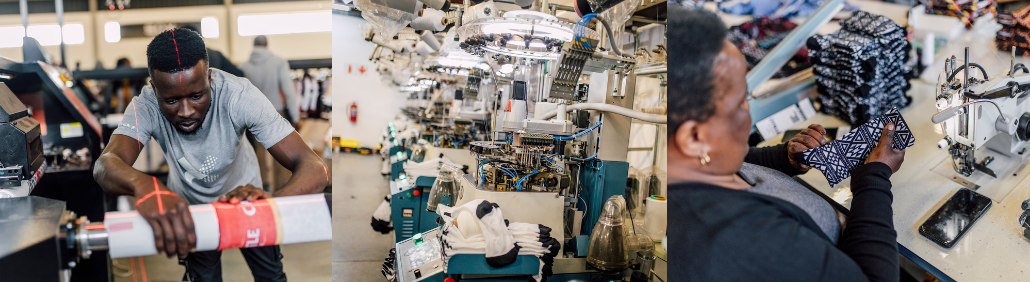
Our client, The Sox Factory, is a Pretoria-based South African sock manufacturer specialising in custom performance and lifestyle socks for brands, teams and international markets. Founded in 2016 to bring sock production in-house and improve quality and lead times, the business now produces tens of thousands of pairs per month for clients locally and overseas, leveraging digital printing, scalable production and strong export processes. Read how they transitioned from local start-up to global supplier, and what lessons their export journey holds for entrepreneurs looking to compete internationally.
1. Can you please share a bit of background information about your business?
The Sox Factory is a South African sock manufacturer based in Pretoria, founded in 2016. It started when the founders launched their own sock brand and realised that outsourced production limited quality and lead times. In 2018, they brought manufacturing in-house, starting with one machine. Today, The Sox Factory employs over 100 staff, produces more than 85,000 pairs per month, manufactures for local and international brands, and was the first factory in Africa to introduce digital sock printing—giving customers speed, flexibility, and full control over quality.
2. Which countries do you export to or import from?
The Sox Factory exports from South Africa to the United Kingdom, Ireland, Germany, France, Switzerland, Italy, Sweden, Poland, Slovenia, Czechia, Lithuania, and Greece. We also supply markets in Namibia, Botswana, Zimbabwe, Mozambique, and Mauritius, as well as international partners in the UAE, Hong Kong, India, Taiwan, Canada, Australia, New Zealand, Argentina, and Chile. Manufacturing is based in South Africa, with selected raw materials imported from specialist international suppliers.
3. When did you realize your business was ready for exporting/importing? What were the key indicators?
We realised we were ready for exporting when we achieved consistent product quality, reliable lead times, and full control over our manufacturing process. Key indicators included repeat orders from international clients, the ability to meet strict branding and compliance requirements, and scalable production capacity. Establishing robust logistics processes, export documentation, and financial controls gave us the confidence to service overseas markets reliably while continuing to grow locally.
4. Can you share some tips for finding and researching international markets for export, or international suppliers for import? Where did you find your best leads?
We focused on an industry we know extremely well—the cycling industry—which became a powerful filter when researching international markets. Cyclists are influential, highly performance- and quality-conscious, and typically fall within a higher LSM bracket, making them ideal early adopters. This focus helped us target the right brands, distributors, and events, generate strong word-of-mouth referrals, and validate new markets more efficiently before expanding into adjacent categories.
5. What was your biggest initial fear or concern about exporting/importing, and how did you address it?
Our biggest initial concern was protecting product quality and our brand reputation once goods left our factory. We addressed this by tightening quality control, documenting every step of production, and working only with reliable logistics partners. Clear communication, approved samples, detailed specifications, and staged shipments helped reduce risk. As confidence grew, repeat orders and long-term relationships confirmed that our processes could perform consistently in international markets.
6. Did you encounter any unexpected obstacles, and how did you adapt?
One of the biggest challenges was ensuring we had the correct export registrations, documentation, and certificates of origin in place. We addressed this by properly registering as an exporter and understanding which trade agreements applied to our products. Using the correct certificates of origin allowed us to access duty-free or preferential tariff treatment, making our products more competitive in foreign markets and giving international customers greater confidence in working with us.
7. Did you attend trade shows or participate in international business development programs? If so, can you mention any that were helpful?
Yes, trade shows played an important role in our international growth. We participated in leading cycling and sports industry events in Europe, including trade shows and festivals where our target market was already present. These events allowed us to meet distributors, brands, and retailers face to face, validate demand, and build long-term relationships. Industry-specific events proved far more effective for us than generic trade exhibitions.
8. What advice do you have for aspiring exporters or importers in South Africa?
Just start! Start with an industry you understand deeply and build a product that can compete on quality, not just price. Get your compliance, export registrations, and documentation right from the beginning, as this directly affects cost and competitiveness. Test markets before scaling, choose reliable logistics partners, and invest in long-term relationships. Most importantly, control your process and reputation—international markets reward consistency, reliability, and professionalism.